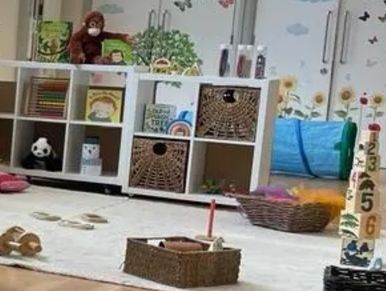
Our baby group has a specific designated area whereby all resources are easily accessible by the babies as they sit or lay on the back / front. This area consists of a range of natural, tactile, sensory resources for them to feel, touch, explore and play with as they continue to explore their environment. We have also set up a black and white segment, with a range of black and white materials, books, soft toys which aids in the development of children's vision.
These natural, open ended resources help to develop imagination and creativity from a very young age. They enable children to appreciate and experience the natural wonder of the resources in the little world around them and enable experience a world of resources beyond the pre-determined limited function of 'plastic toys'.
Alongside their own designated baby area, the babies benefit from other key zones of learning such as the music carpet, story telling/ mini library, the construction area and our outdoor area.
The baby group have a huge focus on building good relationships with adults and peers as learning partners. Adults model language and speak to babies throughout the day, giving babies the chance to respond by waiting and engaging through eye contact and a warm smile.
The Toddler group make use of all the zones of learning alongside the pre-school group.
Toddlers focus is towards developing language and mathematical fluency through daily experiences such as story telling, problem solving, singing songs and so on.
The foundation of knowledge is being built at this stage, as we aim for our children to go towards using these units of knowledge to start to solve more complex problems or think and critically discuss stories as they move into pre-school.
This stage of learning its fundamental for children to continue to engage in sensory activity (as with all ages at nursery) so please expect some days for your child to have taken part in some for of messy play.
As children's language develops so too does their ability to express critical thought and to ask questions/ explore ideas and the world around them.
Children continue to engage in project based learning, while the projects become more advanced and enable the children take even more leadership on where their projects take them.
Focused activities start to shift towards school readiness as children near the end of pre-school and children will start to learn phonics in a fun and pleasant way, promoting school readiness.
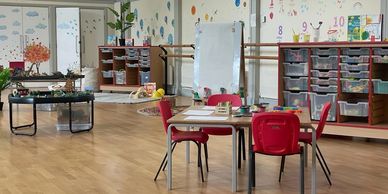
We are so lucky to benefit from a beautifully well-lit learning environment with a very high ceiling and wonderful large windows all around the room letting in an abundance of natural light.
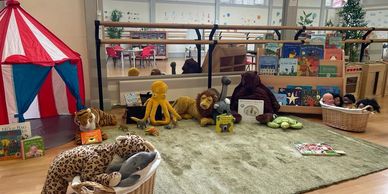
We organise the the learning environment into zones of experience for instance, the reading corner; with puppets, a tent, a comfortable rug, pillows and a range of soft toys/ puppets for the children to (re)create and enjoy story telling with their play partners.
The various zones of learning can be accessed by any child of any age group. However, planned activities will usually target a specific group of children from one of three groups: babies, toddlers or pre-schoolers.
Our zones consist of the following: baby carpet, kitchen role play, story / library, arts and crafts, small world (trains), small world (dinosaurs), music area, construction area, outdoor learning space, sensory/messy play, project based learning zone. Our small world and project based learning zones can change depending on the children's interests.
Apart from the designated baby area, all three groups (babies, toddlers, pre-school) can freely visit any area of learning they wish. Toddlers and Pre-schoolers can re-visit the baby area if they wish, with support from an adult.
Our principles and pedagogy remain consistent across all age ranges. Please see below a few key aspects of our provision that span across all the age groups.
Our primary aim is to ensure that your child is settled and feels familiar, confident and secure in the nursery environment. Our settling in process is robust and we have our own inhouse documentation to ensure that each child has met certain milestones for ensuring that they are settle in well.
The key person is assigned early to ensure that your child builds a consistent bond with whomever is responsible for their developmental progress and journey. The key person is also a play partner and critical in making the child feel secure within the nursery environment.
At all ages, we allow children's interests and inspirations to lead our provision and dictate the activities and resources available. Pre-school children and toddlers are more able to express these interests using language while younger toddlers and babies are able to express themselves non-verbally through emotions, eye contact or happy babbling.
Projects based learning is initiated for all ages based on the children's interests. The projects, growing out of children's inspirations, will naturally become engaging and developmentally appropriate experiences that may span over a week or two and sometimes a couple of months.
Parents are kept informed on our projects through observations and notice boards. We hope that our projects will extend into home so that children can explore their project both at home and at nursery.
Each group has a timetable agreed by the team and these provide structure and a familiar routine for the children. These timetables are revised from time to time depending on the children's needs, what is working well and how the children respond.
8:00 - 9:00am: Breakfast and Free Play
9:05 - 9:15am: Welcome and Greet Circle Time
9:15 – 10:45am: Free Flow, Planned Activity and Snacks
(Some babies may have a morning nap)
10:45 – 11:15am: Nappy Change
11: 15am – 12:00pm: Lunch Time
12:00 – 2:30pm: Nap Time
2:30pm – 2:45pm: Circle/Quiet Time and Snacks
2:45 – 3:45pm: Free Flow and Planned Activity
3:45 – 4:15pm: Tea Time
4:15 – 4:45pm: Nappy Change
4:45 – 6:00pm: Free play
*These times are flexible according to the individual needs of every child*
*In addition to the recorded times, nappies are changed as and when needed in accordance with the child’s needs*
8.30 – 9.30: Breakfast
8.30 – 9.30: Story Time and Free play
9.30 – 9.40: Circle Time
9.40 – 10.45: Focused activity and Snack
10.45 – 11.00: Music and Movement
11.15 – 11.45: Lunch Time
11.45 – 12.00: Mindfulness / Sleep Time
12. 00 – 1.30: Free Play
1.30 – 1.50: Story Time
1.50 – 2.10: Snack
2.10 – 3.10: Focused Activity
3.10 – 3.25: Bucket Time / Musical Instrument
3.30 – 4.00: Tea Time
4.00 - 4.15: Music and Movement
4.15 – 4.40: Free Play
4.50 – 5.10: Yoga / Mindfulness
5.10 – 5.25: Library Time
5.25 – 6.00: Ready to go home
8:00 – 9.00am: Breakfast, Free Flow and Tidy up time
9:00 – 9:20am: Circle time and split into Key Groups
(One staff leading circle time, other staff setting up for free flow and focused activity)
9:20 – 10:40am: Focused Activity, Free Flow and Snack
(Main Room, Focus Room, Outdoors and Construction Room)
10:40 – 11:00am: Whole Group Phonics (then split sleepers into one group)
11:00 – 12:00: Lunch for Sleepers and putting them to bed
11:10 – 11:45am: Non-Sleepers Free Flow Outdoors
11:45 – 12:00: Get Ready for Lunch
12:00 – 1:00pm: Lunch for remaining groups
1:15 – 1:30: Story time/Singing/Exercise time
1:30 – 3:30pm: Split into Groups and Free Flow and Snack
(Main Room, Focus Room, Outdoors and Construction Room)
3:30 – 4:00pm: Tea Time
4:00 – 5:40: Focused Activity, Free Flow and Tidy Up
5:40 – 6:00pm: Get Ready for Home Time